

Credits: Article and images by Nina Scally @ Quill & Pad. See the original article here - https://quillandpad.com/2026/11/28/how-the-blancpain-fifty-fathoms-birthed-the-modern-dive-watch/
When you ask the average watch enthusiast where the modern dive watch came from, they usually point to 1953 and a certain iconic watch bearing a coronet logo on its dial. It’s a fantastic story, heavily reinforced by decades of brilliant marketing. But there’s a much quieter, more French brand that fundamentally changed the history of aquatic timekeeping. Its name is Blancpain, maker of the inaugural Fifty Fathoms watch. Indeed, 1953 was also the year that birthed this very watch, equally as capable and just as stylish as said icon. What many don’t realise is that the Fifty Fathoms actually beat that watch to the punch by several months, becoming the blueprint for the modern-day dive watch right down to the locking bezel and stark black dial. It would come to be the diving instrument that the rest of the industry spent the next seven decades trying to copy. To understand how a traditional Swiss watchmaker like Blancpain ended up defining the international standard for underwater timekeeping, we have to strip away the current context of luxury sports watches.
The Men Behind the Design: Fiechter and the French Navy
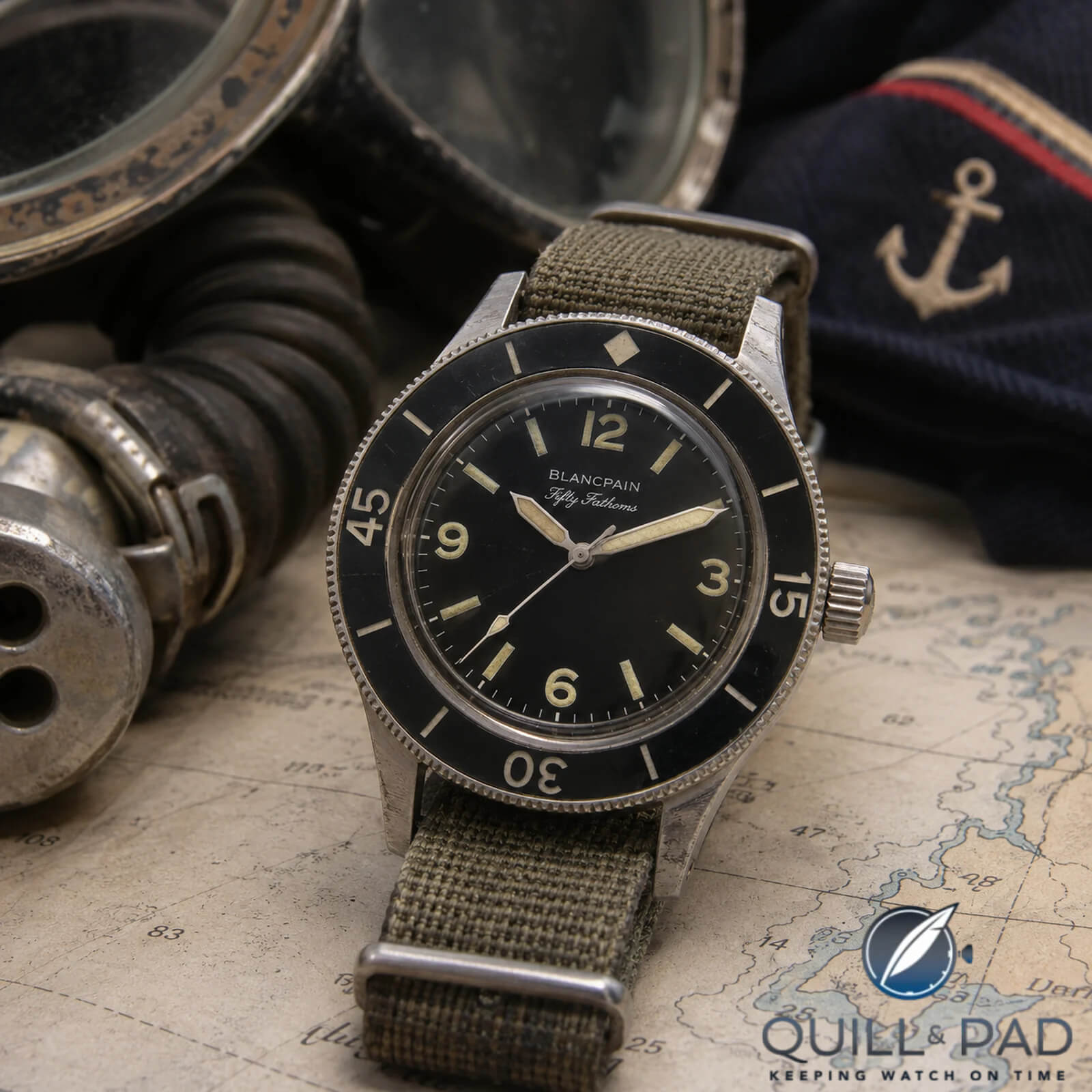
The Fifty Fathoms watch was born out of cold, hard, unglamorous necessity. It was a piece of survival gear, dreamed up by explorers of the dark waters of the Mediterranean. In the early 1950s, Jean-Jacques Fiechter was sitting at the helm of Blancpain – a fiercely dedicated recreational diver at a time when scuba diving was still in its infancy. Picture it. There were no dive computers, and the equipment was primitive.
During a dive off the coast of Cannes in the south of France, Fiechter lost track of time and ran out of air. He had to make a very panicked, emergency ascent to the surface – a terrifying and dangerous experience that can easily result in decompression sickness or worse. Sitting on the boat, catching his breath, Fiechter realised that without a reliable, legible, and waterproof way to track time underwater, scuba diving was like diving with death. He went back to Switzerland and immediately started sketching out a solution. Meanwhile, over in France, Captain Robert “Bob” Maloubier and Lieutenant Claude Riffaud were facing a very similar problem. They’d just been tasked by the French government to create the Nageurs de Combat – the French combat swimmers corps. These guys were tasked with sneaking around in total darkness to blow things up underwater. Naturally, they needed a foolproof way to track their air supply so they didn’t drown in the process.
Maloubier and Riffaud tested every “waterproof” watch on the market, and all failed. They leaked; they shattered. Some of them you couldn’t read in the dark. Maloubier eventually drew up a rigorous specification sheet for a watch that simply didn’t exist, but one that he knew he needed. The watch should have a matte black dial, large luminous markers, a self-winding movement, and an outer rotating bezel to track elapsed time. He shopped his sketches around to several major watch brands, most of whom essentially laughed him out of the room. All but Blancpain, that was.
Unbelievably, the French military had the exact requirements; Fiechter already had the blueprints and the passion to make it happen. Blancpain agreed to produce the watch, and the Fifty Fathoms project was officially green-lit.
Groundbreaking Technical Specifications
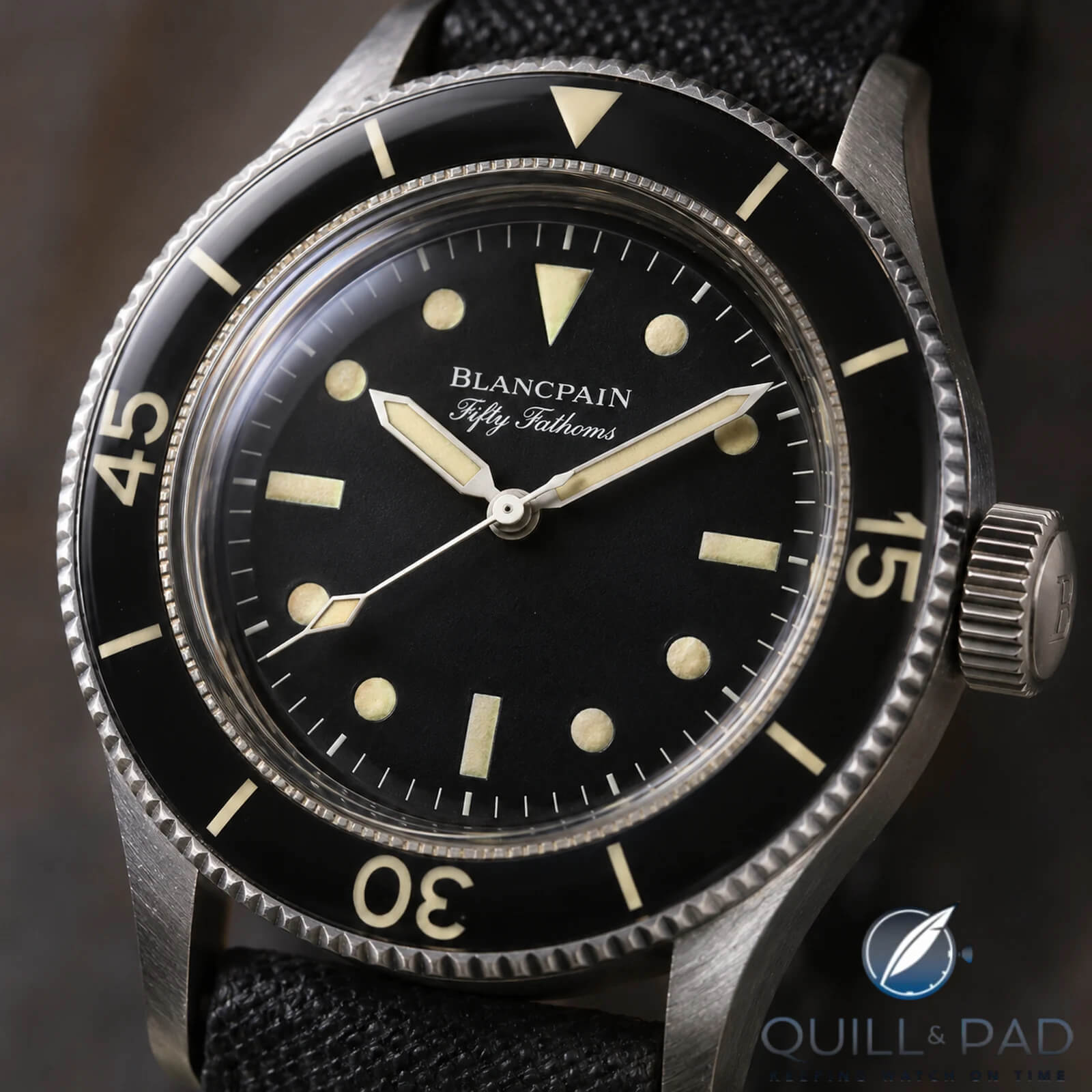
When the Fifty Fathoms debuted in 1953, every one of its features was a direct response to a physical problem encountered underwater. Let’s start with the name: “Fifty Fathoms”. It equates to 91.45 metres, which was considered the absolute maximum safe depth for a diver using all the gear. Blancpain promised a watch that could go as deep as divers could. But getting the design right meant Jean-Jacques Fiechter had to think on his feet. A certain rival brand already held the patent on the screw-down crown, which was the obvious way to seal a case, so Blancpain couldn’t use it. Fiechter came up with a double O-ring system instead, which ultimately meant that if the crown got pulled out underwater, a second seal was still there to lock out moisture. But Fiechter knew that constantly winding the watch or setting the time would eventually wear down those vital rubber seals, so his solution was to use an automatic movement. By outfitting the Fifty Fathoms with the rugged, self-winding A. Schild AS 1361N calibre, the wearer rarely had to touch the crown at all. The rotor did the heavy lifting, keeping the seals intact and the watch watertight.
Next came the bezel, and it may be Blancpain’s biggest contribution to dive watches. Fiechter added a rotating outer bezel so a diver could line up the zero marker with the minute hand easily whilst entering the water. It meant he could read elapsed time at a glance without worrying about the watch getting knocked against a rock mid-dive and shifting the bezel to accidentally extend dive time. Such an accident could kill a diver. The clever bezel design ensured that in order to turn it, you had to press it down first. That idea later grew into the unidirectional bezels we now take for granted.
For its time, the Fifty Fathoms was considered enormous, bearing a 42mm diameter. But it wasn’t about style. The watch needed room for a thick soft-iron inner case to keep the movement safe from the magnetic fields around diving equipment, and the dial was big, matte and black, ensuring the oversized indices and hands could stand out sharply. They were coated in radium paint, too, making it seriously radioactive. Over the bezel’s luminous markers sat an insert of epoxy resin, often called bakelite, to keep saltwater from damaging them.
Expanding the Fleet: Key Versions and Modifications
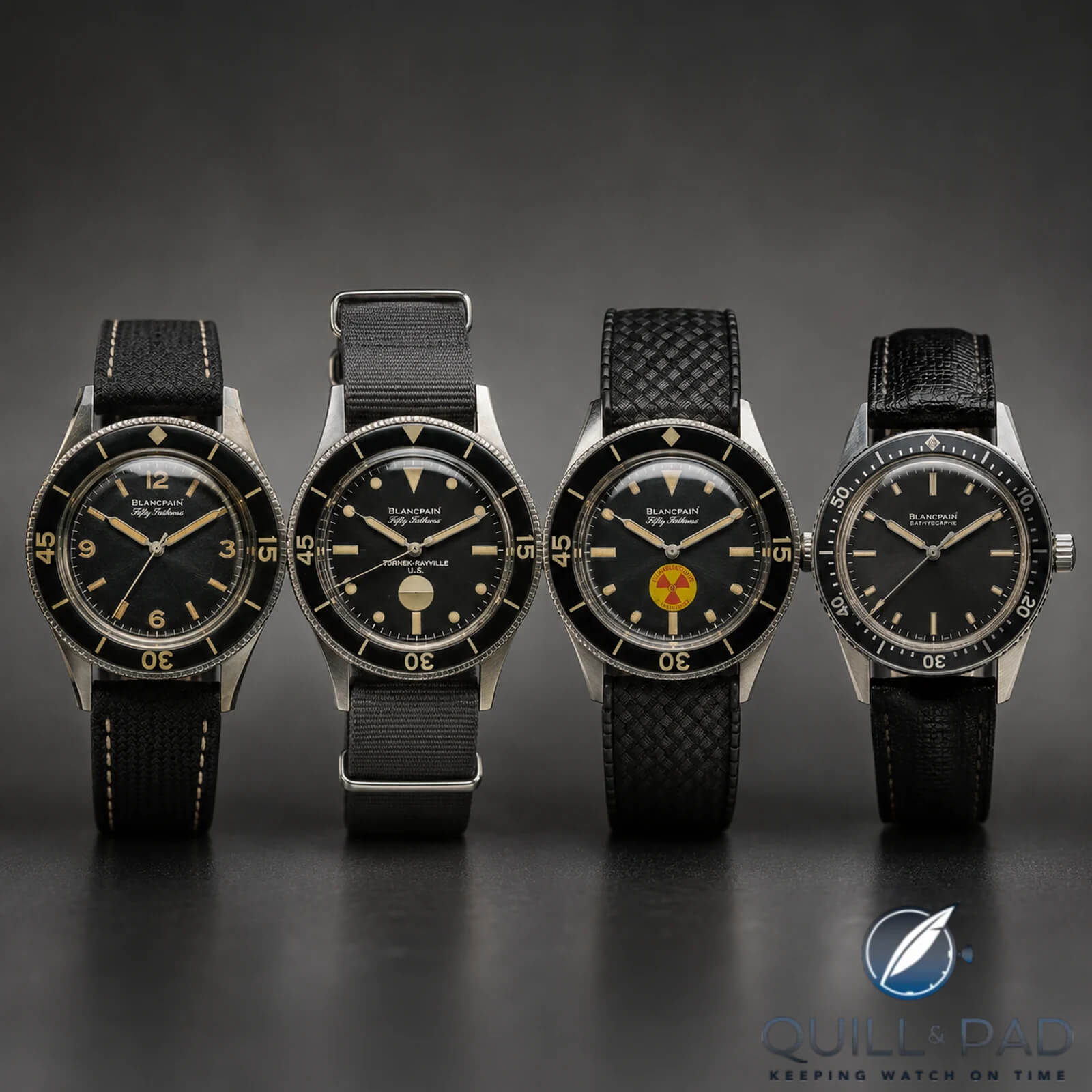
Once the French Navy proved the Fifty Fathoms concept worked, other military forces quickly caught on, and throughout the 1950s and 60s, the model evolved into a sprawling family of specialised military tools, each with its own quirks and legendary status among today’s vintage collectors. Perhaps the most famous iteration came via the United States Navy. Thanks to the “Buy American” Act, the US military couldn’t easily purchase watches directly from a Swiss manufacturer, so to bypass the red tape, Blancpain partnered with an American importer named Allen V. Tornek. The resulting watches were branded “Tornek-Rayville” and brought the innovative moisture indicator to the dial. The Tornek-Rayville MIL-SPEC 1 featured a small circle split into two halves: one pale pink and one blue at 6 o’clock. If even a trace of moisture got into the case, the paper-like material inside would turn pink, warning the diver that the watch had been compromised. It was a clever little design feature that collectors loved.
Then came the shift away from radium. As the health hazards of highly radioactive luminous paint became impossible to ignore, Blancpain transitioned to tritium in the 1960s. To reassure civilian buyers and specific military units (like the German Bundeswehr) that their wrists weren’t going to glow in the dark for a thousand years, Blancpain printed a massive, highly visible crossed-out radiation symbol on the dial. Known today as the “No Radiations” or “No Rad” models, these watches feature an incredibly quirky pop of yellow and red on an otherwise stealthy tool watch, making them some of the most sought-after vintage dive watches on the planet.
Blancpain wasn’t only building for the military; it was also earning real credibility among civilians through a link with Jacques Cousteau’s Aqua-Lung company. Unbeknownst to many, Cousteau and his team wore the watch while filming the Oscar-winning documentary The Silent World. You couldn’t just buy them anywhere, either. Fifty Fathoms were sold in dive shops and sat next to serious diving equipment, which tells you they were meant as sports equipment rather than mere status symbols.
There was a catch for everyday buyers, though. The size. At 42mm, the Fifty Fathoms looked large and overbearing on a 1950s wrist, and wearing it day to day wasn’t really practical. Blancpain acknowledged this problem, and in 1956 brought out the Bathyscaphe model, named after the deep-diving submersible invented by Auguste Piccard. The Bathyscaphe shrank the Fifty Fathoms down to a much more manageable 38mm diameter. It retained the water resistance, the robust automatic movement, and the rotating bezel of the original Fifty Fathoms watch, but presented it in a classically proportioned package that you could actually wear to the pub after a dive.
The Quartz Crisis and the Modern Resurgence
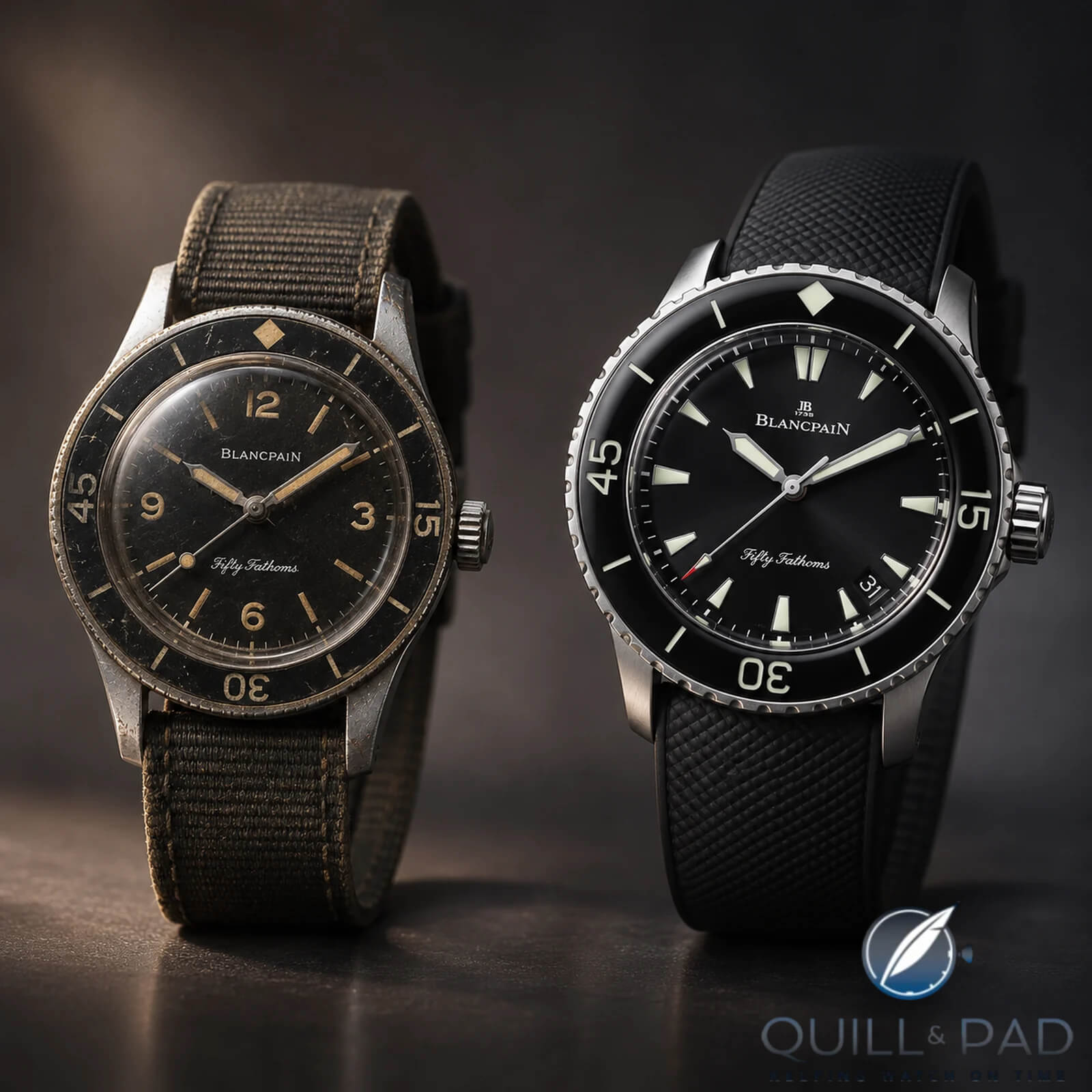
The 1970s soon caught up with the Fifty Fathoms, and the quartz crisis hit the Swiss industry hard, almost overnight, in fact. Mechanical dive watches went from essential tools to relics and, instead, a cheap quartz watch was more accurate, tougher, and far less painful to replace if your watch got damaged. Blancpain went quiet, and the Fifty Fathoms lived on mainly in the memories of retired combat swimmers and vintage collectors. That was until Jean-Claude Biver bought the Blancpain name in the 1980s, of course. He took it in a classical, complicated direction, famously declaring there had never been a quartz Blancpain and never would be. That saved the brand, but a rugged dive watch didn’t sit easily with its new dressy image.
The Fifty Fathoms came back in 1997 as part of the “Trilogy” collection, but its real revival started in 2003, just in time for its 50th anniversary when Marc A. Hayek had taken over as CEO. Like Fiechter before him, he was a keen diver and saw the potential in this watch. He set about rebuilding the watch for the 21st century. The 2003 Anniversary edition kept the combat swimmer spirit but made the Fifty Fathoms a bit more luxurious, which suited people who both dived and collected. The biggest change, however, was the bezel, which saw bakelite and aluminium give way to a domed sapphire insert, along with plenty of lume for enhanced readability. Admittedly, the sapphire bezel was much more expensive to make, but it did look great. Plus, the sapphire gave the bezel a deep, glossy, almost wet look, a lot like the 1950s originals, only now it was far harder to scratch.
Modern Mechanics
Inside, the modern Fifty Fathoms are some seriously impressive mechanics. The current models run on Blancpain’s own Calibre 1315, which has three mainspring barrels linked in series for a five-day (120-hour) power reserve. Pair that with a free-sprung balance with gold regulating screws and a silicon balance spring, and you have a movement that is more than capable of coping with magnetic fields. While the original A. Schild movement was built to be tough and no-nonsense, this one keeps that practical streak, but with far better finishing and engineering.
For a long time, the modern Fifty Fathoms was synonymous with a rather intimidating 45mm case diameter – a size that alienated those of us who don’t possess the burly forearms of a French combat swimmer. But Blancpain has smartly recognised that everyday wearability matters just as much as extreme water resistance. To mark the collection’s 70th anniversary, the brand finally brought the flagship Automatique down to a much more democratic 42.3mm, directly echoing the historical dimensions of that 1953 original that collectors came to know and love. Pair that nice sizing with the brand’s increasing use of Grade 23 titanium and this lightweight alloy drastically cuts down the wrist heft. Suddenly, you have a highly capable, 300-metre dive watch that wears like an absolute dream on a daily basis. It’s this clever balancing act between a solid build and ergonomic refinement that keeps the Fifty Fathoms feeling fresh with every new release.

Today, the collection has expanded to include everything from high-tech ceramic cases and flyback chronographs to complete calendars and even tourbillons. The Bathyscaphe line has also firmly returned, serving as the sharper, more angular, and slightly more versatile sibling to the rounder, more voluminous standard Fifty Fathoms.
The Watch That Changed Everything
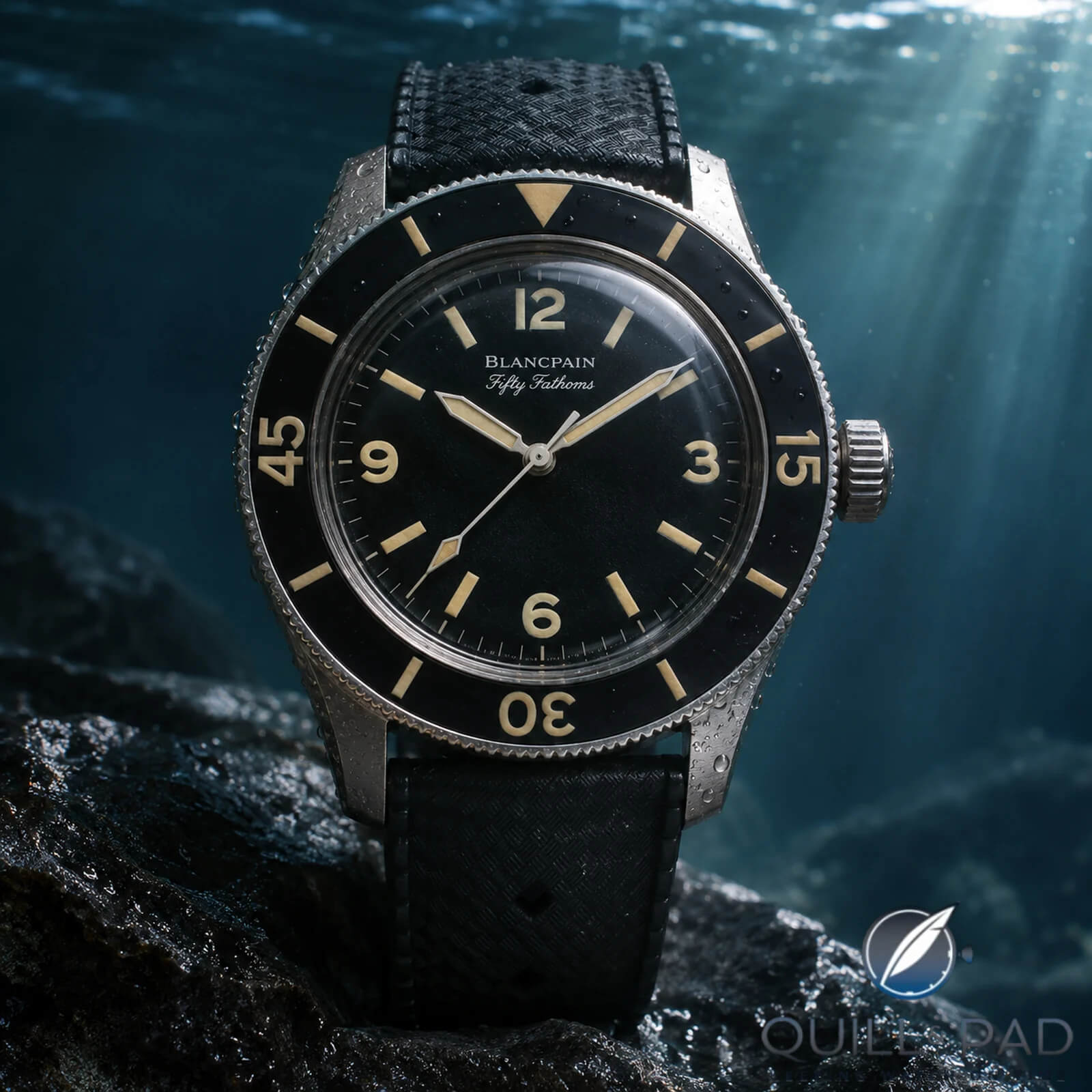
When the International Organization for Standardization eventually sat down in 1996 to write the ISO 6425 standard (the strict criteria a watch must meet to officially call itself a “diver’s watch”) it essentially just copied Jean-Jacques Fiechter’s homework from 1953. Unidirectional bezel? Fiechter did it. A watertight case? Fiechter did it. Today’s Fifty Fathoms watch is an unashamedly luxurious object, finished to a standard that Maloubier and Riffaud could never have imagined, and it commands a price tag that reflects its position at the very top tier of Swiss watchmaking. What’s more, its DNA remains completely intact. It is still, at its core, the definitive blueprint for the everyday dive watch.
Read more like this:
Like in the good old days: black enamel and a pedometer-style self-winding movement
Hands-On: The Armin Strom x Exquisite Timepieces Mirrored Force Resonance Zeitgeist Blue
Ahead of the Curve: The Greubel Forsey GMT Balancier Convexe in Blue
Chasing the Naples Night: The DOXA SUB 200T Afterglow x Exquisite Timepieces
Credits: Article and images by Nina Scally @ Quill & Pad. See the original article here - https://quillandpad.com/2026/11/28/how-the-blancpain-fifty-fathoms-birthed-the-modern-dive-watch/